
Gail Murphy, a Bidgigal and Dungatti artist, painted Healing Hands for the Bondi Medicare Mental Health Centre. This Mental Health Month, we asked her about the story behind the painting, how she creates, and why a little connection goes a long way.
How did you become an artist, and what does painting mean to you?
It’s just a passion. I’ve always loved art, ever since primary school. It’s just been a natural process. Painting means everything to me. It keeps me grounded. If you’re sad, you can put that into your art. If you’re happy, you can put that into your art. It’s a way of refocusing and expressing yourself.
How did you come to create the artwork for the Bondi Medicare Mental Health Centre?
The New Horizons team was working within the JNC (where I work) while the Bondi site was getting prepared and just happened to mention they were looking for art.
A quick note from our Head of Mental Health Services Stephen Suttie:
“While we were setting up the temporary site and establishing the service, Gail was a great connector and referred a number of people to us. It was the start of a fantastic relationship; Gail gave us lots of support navigating cultural issues, particularly advice about the signage for the centre.
“I asked Gail about local artists as I wanted to commission a piece for the centre and she told me about her artwork and how she was doing a piece for the JNC Branding and Annual Report. It just made sense to have Gail do the artwork about connection and place given the connecting she had done for us and the relationship that was forming. It adds to the meaning of the painting for us“.
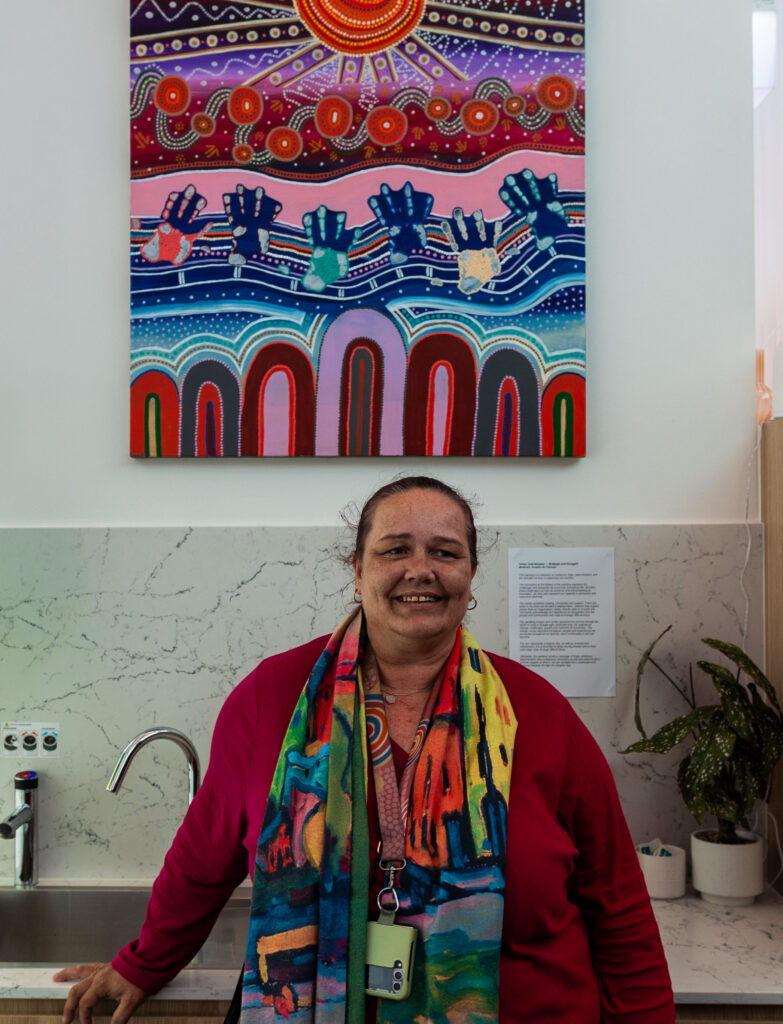
Artist: Gail Murphy, Bidgigal and Dungatti
Title: Healing Hands
Materials: Acrylic on canvas
What is the artwork about?
Healing Hands is a reflection on resilience, hope, determination and the strength we find in supporting one another. The whole artwork is a story, from beginning to end. At the bottom you have objects like mountains, which symbolise the ups and downs of life, overcoming things and getting to the other side. That goes hand in hand with mental health, because it’s about getting past that initial feeling and getting to a better feeling.
The water is the land I’m on, and the hands are meant to be healing hands, because sometimes we need someone else to help lift us up. It’s about asking for help, speaking to someone, and leaning on one another.
The circles and spirals are the journey of life. It’s a journey going up and down, which is why it’s not a straight line. All along the way you meet people and organisations, and they all have different effects on your life, hopefully for the better. That’s why there are little footprints too.
The last part is the sun. It’s about a brighter day, and overcoming things to achieve that brighter day. It’s also the creator of life, which is why it’s right up the top, because that’s what makes life and gives us a sense of renewal and hope.
What materials did you use?
It’s acrylic paint on canvas. At this stage in my life it’s the only thing I use. I’d like to try different mediums down the track.
Do you have a favourite colour to work with?
My favourite colour is purple, but I like to use bright, contemporary colours in my art, because bright colours are happy. That resonates with me, and it seems to resonate with others. It draws you in when it’s nice and bright.
Why do you think art matters in a place where people come for support?
There have been places I’ve walked into where the first thing I see is the artwork. It can create common ground. People can look at it, and it breaks the ice already. You don’t know one another, but you might both like the same artwork. Brightness might make you feel good.
When you hear “a little connection goes a long way”, what comes to mind?
It’s exactly what I talk about in the painting: we need to help one another in life. We can’t always make the journey on our own. People come to you, especially with mental health, and they can’t do it on their own. I think that’s why it resonates.
Does your art connect you to others, to culture, or to Country?
Big time. When my mum passed away, I almost felt like my connection to where I was from was lost, because Mum used to live there. When I wasn’t there, I felt like I didn’t have that common ground. Artwork, for me, is my connection back to culture, and it also connects me to others. I do an art program now. It brings us together and gives us that common ground.
Can you share a moment when a small act of connection made a difference?
I love my job (as an Aboriginal community engagement facilitator at the JNC) because I get to help people who were essentially me when I was lost, or when I wasn’t sure of the direction I was going. I have people come into work and I get to help them. It’s quite empowering, so I love getting to connect with people and trying to empower them. That’s priceless.
If you or someone you know needs support, call Lifeline on 13 11 14, or 13YARN on 13 92 76 to talk with an Aboriginal or Torres Strait Islander Crisis Supporter.